The Deeply Rooted and Subtle Islamophobia of the West
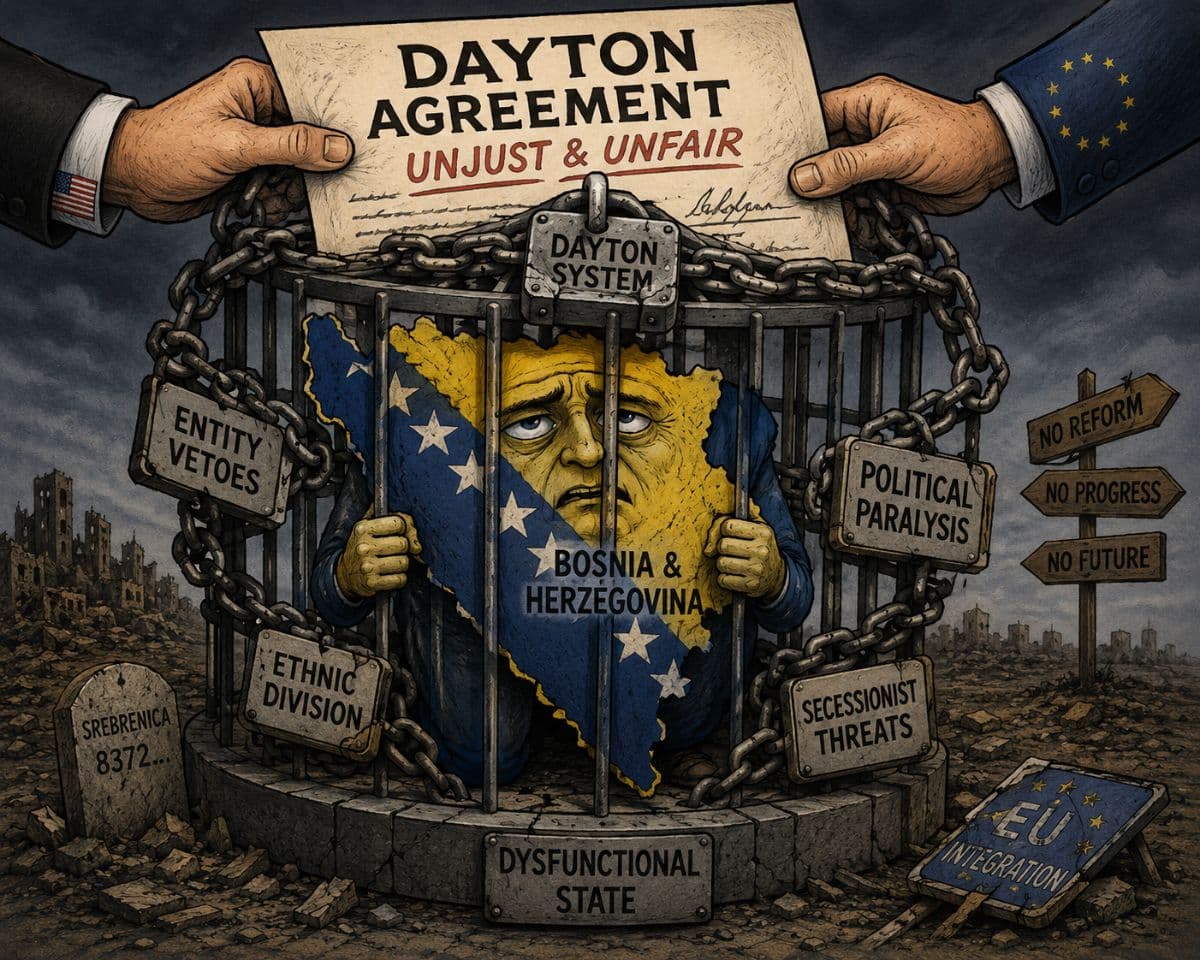
The Dayton Peace Agreement brought an end to the war in Bosnia and Herzegovina at an exceptionally sensitive moment. By late 1995, the Army of the Republic of Bosnia and Herzegovina was gaining significant momentum on the battlefield, and there were realistic prospects for further advances toward Banja Luka as well as for cutting the territory of republika srpska into two separate sections in the Brčko corridor. For this reason, the decision to halt military operations and bring the warring parties to the negotiating table generated suspicion and skepticism among many citizens of Bosnia and Herzegovina.
The pressure exerted by the United States and the European Union on the President of the Republic of Bosnia and Herzegovina, Alija Izetbegović, to accept negotiations came at a time when the pro-Bosnian political and military bloc had, for the first time, achieved a significant advantage on the ground. For many observers, this raised an important question: why did the international community insist on stopping military operations precisely at that moment, rather than earlier during the years when Bosnia and Herzegovina was subjected to aggression, sieges, ethnic cleansing, and mass atrocities?
The Dayton Agreement undoubtedly brought peace and ended the bloodshed. At the same time, however, it institutionalized a complex and often dysfunctional political system. Republika srpska, established during a war marked by grave crimes and later genocide-related judicial rulings, became one of the two entities of internationally recognized Bosnia and Herzegovina. Many argue that this effectively legitimized realities created through war and that the victims of aggression never received full political justice.
The broader international context of the period raises additional questions. Following the collapse of the Soviet Union, the world entered a unipolar era in which the United States emerged as the dominant global power. If Western powers possessed the political, military, and diplomatic capacity to stop the war, why did they fail to act sooner? Why did it take four years of systematic violence, concentration camps, the siege of Sarajevo, and ultimately the genocide in Srebrenica before the international community responded more decisively?
One explanation frequently advanced by Bosniak intellectuals and political analysts is the existence of deeply rooted prejudices toward Muslims within segments of the Western political establishment. According to this interpretation, Bosnia and Herzegovina was not viewed solely as a victim of aggression, but also as a country with a Muslim-majority population whose strengthening did not align with certain geopolitical and ideological interests. Advocates of this perspective argue that such perceptions contributed both to the slow international response and to the manner in which Bosnia’s post-war constitutional order was designed.
The result is a political system that continues to produce institutional paralysis. Veto mechanisms, a highly complex governmental structure, and broad opportunities for political obstruction often enable actors who openly challenge the sovereignty and integrity of Bosnia and Herzegovina to impede its functioning and development. Consequently, many citizens feel that the country remains trapped within an institutional framework that prevents it from implementing essential reforms and accelerating its path toward European integration.
At the same time, the international community has retained significant influence through the Office of the High Representative. Although these powers were intended to preserve peace and stability, critics argue that they have not been used effectively enough to remove political blockages and facilitate the construction of a functional democratic state. As a result, an important question remains: is there genuine willingness among international centers of power to see Bosnia and Herzegovina become a fully functional, democratic, and equal member of the European Union?
Three decades after the end of the war, Bosnia and Herzegovina is still searching for answers to many questions about its recent past. Among the most significant is whether the Dayton Agreement was merely a necessary compromise to stop the war or whether it reflected a broader policy willing to sacrifice the principles of justice in the name of geopolitical stability. The answer to that question continues to shape political debates in Bosnia and Herzegovina and the attitudes of its citizens toward the international community.