Between Dayton and the Future; Should the pro-Bosnian forces demand the abolition of the entity?
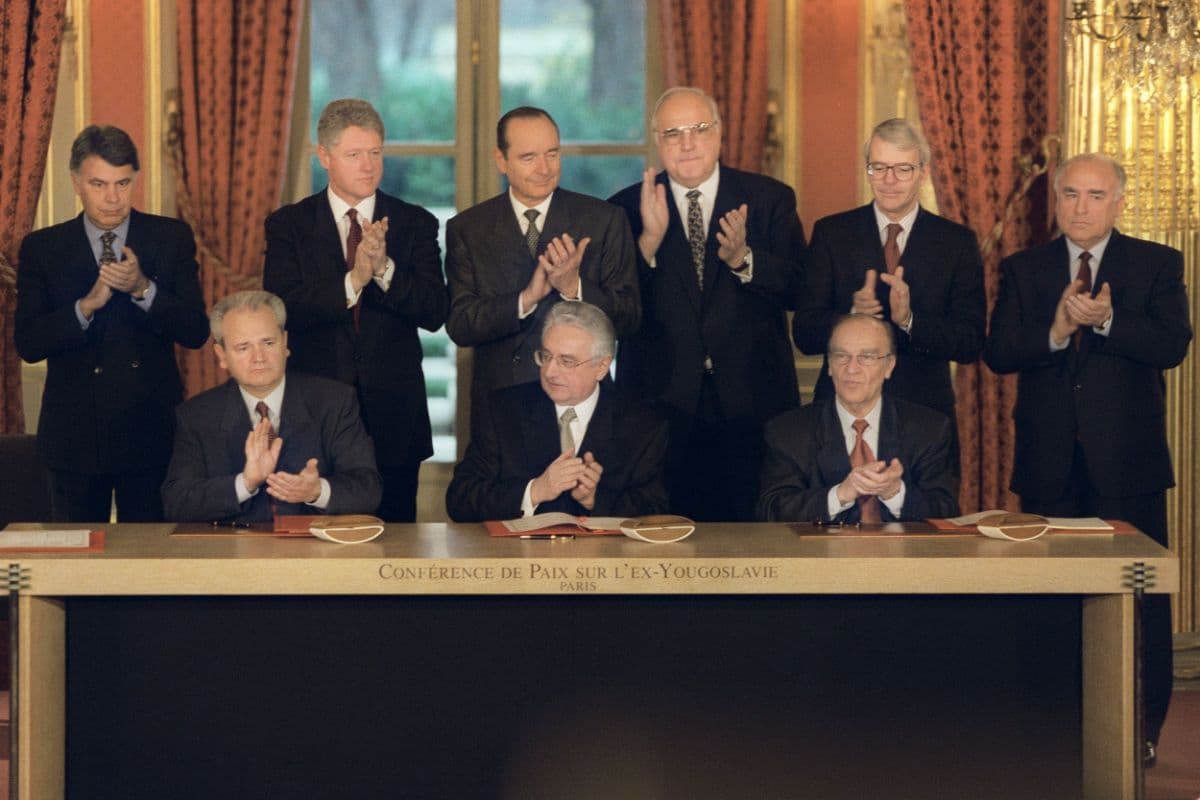
More than three decades after the signing of the Dayton Peace Agreement, Bosnia and Herzegovina is still in a state of permanent political crisis. Instead of the gradual strengthening of state institutions and the consolidation of the political system, we are witnessing continuous attempts to challenge the statehood of Bosnia and Herzegovina, weaken its institutions and redefine the constitutional order established in Dayton.
In this process, the key role is played by political actors who dominantly represent the Serbian and Croatian electorate - SNSD and HDZ BiH - with the open or covert support of the political centers of power from Belgrade and Zagreb. Their policies, although different in methods, have a common goal: redefining Bosnia and Herzegovina as a weak, decentralized and functionally limited state.
SNSD, led by Milorad Dodik, has been pursuing a policy of systematically challenging state institutions for years. From denying the competence of state bodies, through attempts to take over state property at the level of the Republika Srpska entity, to open demands for the abolition of the institution of the High Representative and the marginalization of the Constitutional Court of Bosnia and Herzegovina, this policy represents a direct challenge to the Dayton constitutional order. Dodik's strategy is not aimed at reforming Bosnia and Herzegovina, but at gradually increasing the autonomy of Republika Srpska to the point where state institutions would become only a formal framework without real power.
On the other hand, HDZ BiH has been insisting on changes to the electoral system for years under the rationale of protecting the rights of the Croatian people. The key demand relates to the creation of a special Croatian electoral unit, that is, mechanisms that would guarantee that political representatives of Croats are elected exclusively by voters who identify themselves as Croats. Critics of this policy warn that such a model would represent an introduction to further territorial and political ethnicization of Bosnia and Herzegovina, and in the long term, a step towards the formation of a third entity.
Despite these challenges, pro-Bosnian political forces during the last thirty years have mostly acted defensively. Their political strategy most often came down to repeating indisputable principles such as the protection of sovereignty, territorial integrity and the internationally recognized borders of Bosnia and Herzegovina. Although these principles are fundamental and unquestionable, the question arises as to whether they are sufficient in themselves as a response to coordinated political projects that aim to transform or weaken the state.
The experience so far shows that Sarajevo did not succeed in imposing its own political agenda, but mostly reacted to initiatives coming from Banja Luka and Mostar. Such an approach has created a situation in which pro-Bosnian politics often acts as a guardian of the existing situation, while its political opponents act with clearly defined and ambitious political goals.
That is why the question is increasingly being asked whether the time has come to redefine the state-building strategy. Instead of an exclusively defensive approach, part of the political public believes that the pro-Bosnian forces should articulate their own vision of the country's constitutional transformation. In this context, there are proposals to abolish the entity structure and establish a more functional federal structure based on the regional or cantonal principle.
Proponents of such a model remind that the Republika Srpska was created in the context of a war marked by mass crimes, ethnic cleansing and genocide against Bosniaks, which was also confirmed by the judgments of international courts. According to their opinion, the long-term stability of Bosnia and Herzegovina is not possible as long as the political system rests on territorial units that are the result of war circumstances and ethnic homogenization of the population.
The model of federalization of the entire country according to the cantonal or regional principle, according to this logic, could enable a more equal relationship between all citizens and peoples, reduce ethnic blockades and strengthen central state institutions. Such a reform would represent a radical turn in relation to the existing constitutional framework, but at the same time it would open up space for a serious discussion about what kind of Bosnia and Herzegovina we want in the coming decades.
Of course, the realization of such ideas would face numerous political and international obstacles. The Dayton Agreement still represents the basis of the constitutional order, and any serious reform would require a broad political consensus that currently does not exist. However, the fact that a certain goal is difficult to achieve does not mean that it should not be discussed or politically articulated.
The key question for pro-Bosnian political actors today is not only how to defend the existing Bosnia and Herzegovina, but also what kind of Bosnia and Herzegovina they want to build in the future. Without a clear state-building vision, the political struggle will continue to be reduced to reacting to the moves of other actors. In contrast, articulating one's own political project could represent the first step towards regaining the political initiative and opening a new phase of the struggle for a functional, democratic and sustainable state of Bosnia and Herzegovina.