The last nail in the coffin called "brotherhood and unity"
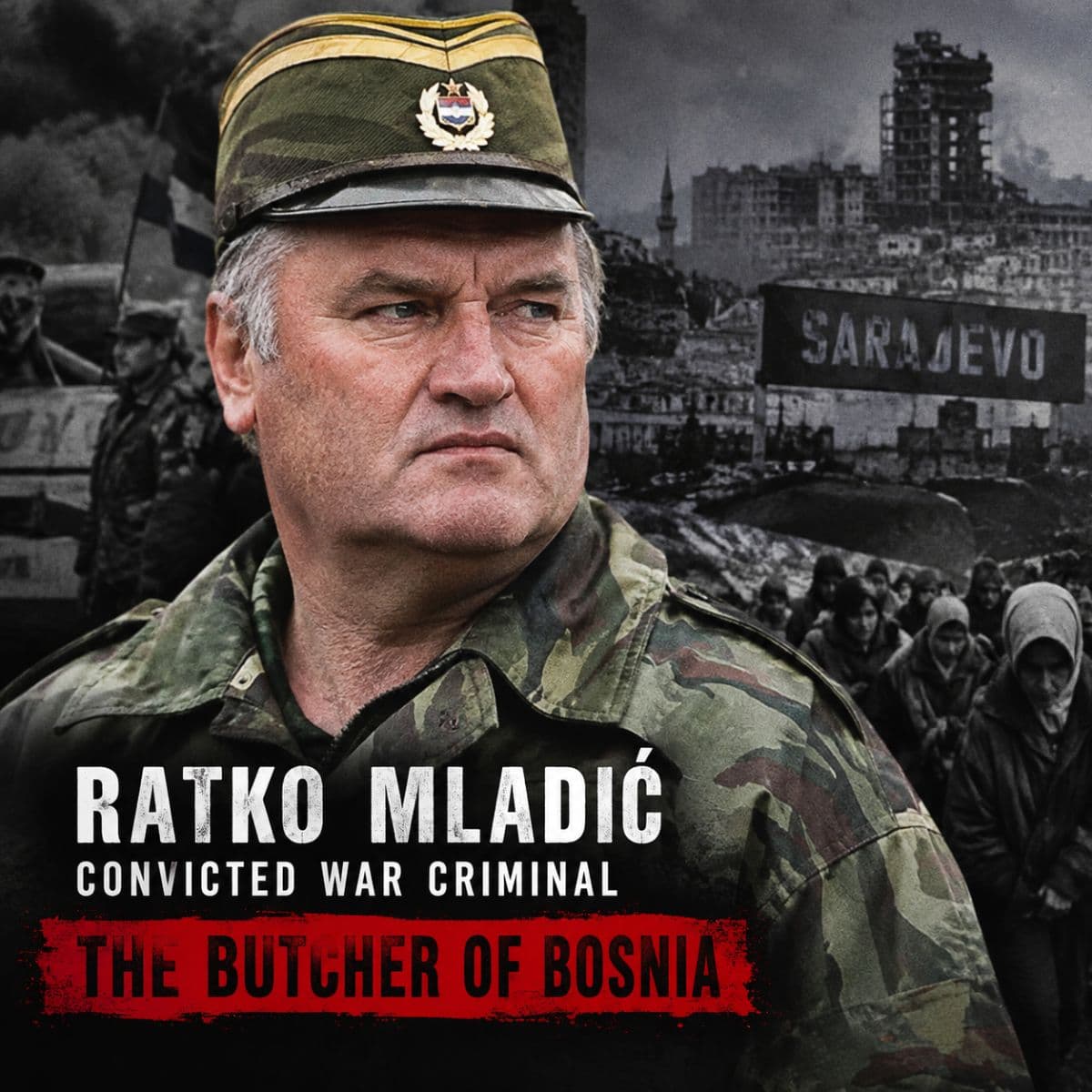
The death of convicted war criminal Ratko Mladić has reopened a question that has been suppressed, relativized, or postponed for some three decades in Bosnia and Herzegovina: is there truly a shared political and social future if a significant part of society is unwilling to confront the crimes committed in its name?
For many in Sarajevo, the reactions that followed Mladić’s death were not merely shocking. They represented yet another painful reminder that the process of coming to terms with the past in Bosnia and Herzegovina has not unfolded in anything resembling the way many expected after the end of the war.
Part of Sarajevo’s public was left stunned by scenes glorifying a man who was finally convicted by an international court of the gravest war crimes, including the genocide in Srebrenica. Particularly troubling is when such reactions do not come only from marginal groups, but can also be found within parts of Serbia’s political and institutional establishment and within the political life of Republika Srpska.
This is precisely where the myth that time alone will heal the consequences of war comes to an end.
A Society That Has Not Completed the Process of Coming to Terms with Its Past
One of the greatest illusions of post-war Bosnia and Herzegovina has been the assumption that generational change would automatically lead to reconciliation. As if a new generation, freed from direct experience of the war, would simply reject the nationalist myths of its parents and build more normal relations.
But time alone does not produce catharsis.
Catharsis requires confronting the facts, acknowledging responsibility, distancing oneself from war criminals, and establishing a social consensus that certain values are unacceptable regardless of the national identity of the perpetrators.
When a war criminal is turned into a hero, the victim into the culprit, and a judgment of an international court into a subject of political dispute, time does not heal society. It merely allows old myths to be passed on to a new generation.
That is why the most important question is not what happened to Ratko Mladić himself, but what his legacy represents today.
Mladić was not merely an individual. He was a military commander of a political and military structure. His biography cannot be separated from the policies that led to the siege of Sarajevo, mass expulsions, ethnic cleansing, and the genocide in Srebrenica.
That is why the way a society responds to his death says far more about that society than it does about Mladić himself.
The Problem Is Not Only Mladić, but the Political Culture That Turns Him into a Symbol
The problem arises when a society is unable to distinguish between national identity and crimes committed in the name of that identity.
Serbian society, like every other post-conflict society, has the right to its own national identity, historical memory, and political interests. But none of these requires the defense or glorification of war criminals.
On the contrary, a mature society must be capable of saying: “This was done in our name, but it is not something we accept as a value.”
That sentence represents the boundary between patriotism and nationalist mythology.
When such a distinction is absent, war commanders become symbols of national pride, court judgments are portrayed as political conspiracies, and victims become obstacles to building “normal relations.”
And so a vicious circle emerges in which each new generation inherits not only the memory of the war, but also an unresolved relationship with its causes and consequences.
What Does “Living Together” Actually Mean?
For three decades, Bosniaks have been called upon to embrace coexistence. And historically and politically, this is understandable.
Bosnia and Herzegovina has no alternative to different peoples living alongside one another. Geography cannot be changed, and the past cannot be erased.
But coexistence does not mean collective amnesia.
Coexistence does not mean demanding that the victim stop speaking about the crime so that the perpetrator can feel more comfortable. Nor does coexistence mean accepting the idea that all sides were “equally guilty” simply because such an interpretation is politically more convenient.
True coexistence can exist only on the basis of a minimum set of shared values.
Among them must be an unequivocal rejection of genocide, ethnic cleansing, and war crimes.
Without that, reconciliation cannot be built. What is being built instead is merely a new modus vivendi — a temporary agreement not to discuss the most important issues.
And that is not peace.
It is a frozen conflict.
Serbia and the Question of Political Responsibility
Serbia occupies a particularly important place in this story.
Serbia is not being asked to renounce its Serbian identity, its national interests, or its right to preserve its own historical memory.
But a state that wants to be part of the European political space must be capable of clearly distancing itself from people who have been finally convicted of the gravest international crimes.
This is not a question of Bosniak or Serbian nationalism.
It is a question of the civilizational minimum.
The European Union, meanwhile, faces a test of its own credibility. If European values remain limited to declarations, while serious consequences for the glorification of war criminals never materialize, the message is that European politics is willing to tolerate almost anything when sufficiently strong geopolitical interests are at stake.
That is precisely why the European Union’s response should not be merely symbolic.
But external pressure cannot solve a problem that must primarily be addressed within the societies themselves.
Brussels can impose conditions, sanctions, negotiate, and apply pressure. It cannot force a society to genuinely accept the suffering of others as its own moral concern.
The End of an Illusion
Perhaps the greatest mistake of Bosniak politics over the past three decades has been treating “coexistence” as an end in itself.
Coexistence is not the goal.
Coexistence is a consequence.
It emerges when different communities accept certain rules of the game: the territorial integrity of the state, political equality of citizens, the right to a distinct identity, but also the universal condemnation of crimes.
If one side expects the other to forget its dead while simultaneously celebrating the people responsible for their deaths, then genuine reconciliation cannot be said to exist.
What exists instead is political coexistence.
And Bosnia and Herzegovina has been living under precisely this kind of coexistence for three decades.
That is why the question that must now be asked in Sarajevo is not: “How can we finally live together?”
That question is incorrectly framed.
The right question is:
**Under what conditions can we live together?**
The answer must be clear.
No denial of genocide.
No glorification of war criminals.
No relativization of victims.
No political violence.
No denial of the right of others to be who they are.
These are not maximalist Bosniak demands. They should be the minimum standards of any democratic society.
The Final Nail in the Coffin
The “Brotherhood and Unity” that existed in socialist Yugoslavia has long since ceased to exist. Its final nail may not have been hammered in by the death of Ratko Mladić, but the way different parts of the post-Yugoslav space respond to his legacy represents yet another indication of how little remains of the illusion that political and social relations can simply return to the state they were in before the 1990s.
Bosnia and Herzegovina therefore does not need a new version of Brotherhood and Unity.
Nor does it need a new politics of hatred.
It needs a realistic policy toward its neighbors.
That means simultaneously rejecting both the naive belief that nationalism will disappear on its own and the dangerous idea that it is impossible to live alongside all Serbs.
Because the problem is not that someone is Serbian.
The problem arises when a criminal is turned into a hero simply because he belongs to “our” nation.
And this is precisely where Bosnia and Herzegovina’s most difficult task begins: to build a society that is prepared to live with its neighbors, but that will never again be willing to pay the price of coexistence by remaining silent about its own victims.
Peace without truth can be nothing more than a pause between two conflicts. Genuine peace begins only when a society is prepared to confront its own past without myths and without excuses.**